If you have searched for anything on Google recently, you may have noticed something different. Instead of a list of blue links, you often get a neatly written answer right at the top of the page, sometimes with no need to click through to a website at all. This is not a small design change. It is a sign of how the entire internet is being searched, read, and understood. In 2026, ranking number one on Google is no longer the finish line. Being the source that ChatGPT, Perplexity, or Google AI Overviews quotes when answering a question is quickly becoming the real goal. This shift has a name, and actually two names, GEO and AEO, and understanding them is now essential for any Indian business that wants to stay visible online. At Devant IT Solutions, we have been tracking this change closely, and it is reshaping how we think about digital visibility for the businesses we work with.
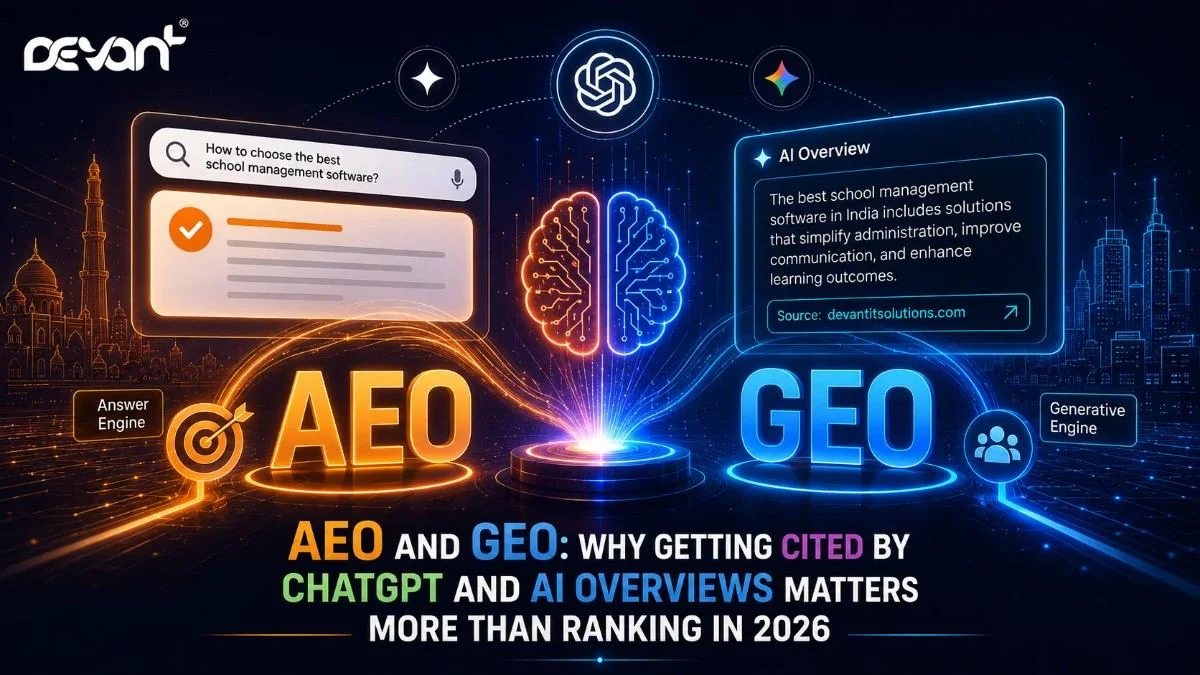
GEO stands for Generative Engine Optimization, and AEO stands for Answer Engine Optimization. Both are close cousins of traditional SEO, but they are built for a very different kind of search experience. Traditional SEO was designed for an era when search engines showed a list of links and left it to the user to click, read, and compare. GEO and AEO are designed for an era where the search engine itself reads the content, understands it, and hands the user a direct answer.
Generative Engine Optimization is about making sure your content is written, structured, and trusted enough that AI tools like ChatGPT, Google Gemini, and Perplexity choose to pull information from it when generating a response. Answer Engine Optimization is closely related but focuses specifically on structuring content so that it can directly answer a question, the way a featured snippet or a voice assistant reply does. Together, GEO and AEO are about earning a citation, a mention, or a direct quote inside an AI generated answer, rather than simply earning a click from a search results page.
For Indian businesses, this matters more than it might first appear. Millions of people now open ChatGPT or use Google's AI Overviews before they even think about typing a query into a traditional search bar. A person searching for the best school management software, a reliable digital marketing partner, or the top data analytics company in India might never scroll through ten blue links again. They will simply read what the AI tells them, trust it, and move on. If your brand is not part of that answer, you effectively do not exist to that customer.
India has one of the fastest growing bases of AI tool users in the world. Students use ChatGPT to research colleges and careers. Small business owners ask Perplexity to compare vendors before making a purchase decision. Professionals rely on Google AI Overviews to get quick, reliable answers without wading through pages of content. This behaviour is not a passing trend, it is becoming the default way people look for information.
This creates both a challenge and an opportunity. The challenge is that traditional SEO efforts, built purely around keyword stuffing or chasing rankings, are starting to lose their impact because fewer people are even looking at the search results page. The opportunity is that businesses who adapt early and optimise for GEO and AEO can position themselves as the trusted source that AI systems pull answers from, long before their competitors catch up.
This is exactly where a strong Generative Engine Optimization India strategy becomes valuable. Businesses that invest in AI search optimization India today are essentially building the foundation of their digital visibility for the next several years. Waiting until AI-driven search becomes the obvious norm means starting from behind, while competitors who moved early have already built up trust, citations, and authority in the eyes of these AI systems.

It helps to understand exactly what changes when you move from ranking-focused SEO to citation-focused GEO and AEO. The mindset shift is significant, even though many of the underlying principles of good content still apply.
Traditional SEO often rewarded content that repeated a keyword a certain number of times, or that targeted one very specific search term with laser focus. GEO and AEO work differently. AI systems are not counting how many times a keyword appears. Instead, they are trying to understand how deeply and accurately a website covers an entire subject.
This means a business offering school management software, for example, benefits more from having a well connected library of content that covers admissions, attendance tracking, fee management, and parent communication, rather than one page stuffed with the same keyword repeated over and over. When an AI model sees a website that clearly understands a topic from multiple angles, it is far more likely to treat that website as a reliable source and pull information from it.
Search engines and AI models increasingly think in terms of entities rather than just words. An entity could be your company, your service, a person, a location, or a concept. Instead of just matching keywords, AI systems try to understand who you are, what you do, and how you relate to other entities in your industry.
This is why building a clear, consistent, and well documented brand identity across your website, social profiles, business listings, and industry directories matters so much now. When an AI model can confidently identify your business as a genuine expert entity in a particular field, it becomes far more comfortable citing you as a source.
Structured data, often added through schema markup, acts like a translator between your website and the machines trying to read it. It tells search engines and AI crawlers exactly what a piece of content is, whether it is a product, a service, a review, an event, or a frequently asked question.
Well implemented structured data makes it far easier for AI tools to lift accurate information from your pages and present it correctly in an answer. Without it, an AI model has to guess at the meaning of your content, and that guesswork often means it simply moves on to a competitor's page that makes its intent clearer.
Experience, expertise, authoritativeness, and trustworthiness, often shortened to E-E-A-T, has been part of Google's thinking for a while, but it has become even more central in the age of AI-generated answers. AI systems are cautious about which sources they cite because a wrong or misleading answer damages their own credibility.
This means genuine author information, real case studies, transparent business details, and honest, well researched content carry more weight than ever. A blog written by someone who clearly understands the subject, backed by a business with a visible track record, has a much better chance of being trusted and quoted by an AI system than generic, unverified content.
Perhaps the biggest mindset shift is this: in traditional SEO, success was measured by where you appeared on a results page. In GEO and AEO, success is measured by whether an AI system chooses to mention your brand, quote your content, or link back to your website inside its generated answer. This is a fundamentally different kind of visibility, one that depends on being genuinely useful and clearly structured rather than simply being technically optimised.

Adapting to this new landscape by hand, page by page, is slow and difficult, especially for businesses managing dozens or hundreds of pages of content. This is where AI automation tools and intelligent agents have become an essential part of any serious Answer Engine Optimization services strategy.
One of the first things these tools help with is monitoring what is called AI Share of Voice. In simple terms, this means tracking how often your brand, your products, or your services are mentioned when people ask AI tools questions related to your industry. Just as businesses once tracked their keyword rankings, they now track how frequently ChatGPT, Perplexity, or Google AI Overviews mention them compared to competitors. Automation tools run these queries at scale, across many topics and phrasings, and report back a clear picture of where a brand stands in the AI-generated conversation.
Another growing area is LLM referral traffic tracking. When someone clicks through from a ChatGPT response or a Perplexity answer to your actual website, that visit shows up differently in analytics than a traditional Google search visit. AI automation tools help identify and separate this traffic, so businesses can clearly see how much value is being generated from being cited inside AI answers, rather than just from traditional search rankings. This data is becoming just as important as regular website traffic reports, because it shows whether GEO and AEO efforts are actually translating into real visitors and potential customers.
Citation visibility is another area where automation plays a big role. Specialised tools can scan AI-generated answers across different platforms and check whether a business is being mentioned accurately, whether the information quoted is correct, and whether competitors are being cited more often for the same questions. This kind of monitoring used to be nearly impossible to do manually, since it would mean asking hundreds of questions across multiple AI tools every single week. Automation makes it practical and consistent.
Perhaps the most powerful use of AI agents in this space is automating content and schema updates. Instead of a content team manually rewriting pages or adding structured data one by one, intelligent agents can scan a website, identify pages that are missing schema markup, outdated information, or unclear structure, and either flag them for review or apply updates directly. This keeps a website continuously optimised for AI discoverability without requiring constant manual effort, which is especially valuable for businesses with large or fast growing websites.
Devant IT Solutions has been paying close attention to this shift, using a combination of entity profile building, structured data implementation, and AI-bait content strategies designed specifically to be picked up by generative engines. As a leading digital marketing and SEO company in India, Devant IT Solutions helps businesses move beyond simply chasing rankings and instead build the kind of authoritative, well structured, and trustworthy online presence that AI systems are far more likely to cite. This includes everything from technical schema work to citation building on trusted industry platforms, all aimed at helping Indian businesses show up confidently inside AI generated answers.
The good news is that adapting to GEO and AEO does not mean throwing away everything that already works. Good, well researched content, a technically sound website, and a genuine understanding of your audience's questions remain the foundation. What changes is the depth of coverage expected, the emphasis on structured data, and the importance of being recognised as a clear, trustworthy entity rather than just a page that happens to rank.
Businesses that start reviewing their content for topical gaps, adding proper schema markup, building a consistent brand presence across the web, and paying attention to how AI tools are already describing them, will be in a far stronger position over the next few years. Those who wait until this becomes common knowledge may find that competitors have already secured the trust and citations that are difficult to win back once established..
Search is changing faster than most businesses realise, and the shift from ranking to being cited is not a distant future trend, it is happening right now, every time someone asks ChatGPT or Perplexity a question instead of typing it into Google. GEO and AEO are not passing buzzwords, they represent a genuine change in how information is discovered, trusted, and shared. Indian businesses that take Generative Engine Optimization India and Answer Engine Optimization services seriously today are setting themselves up to be the names AI systems reach for tomorrow. The businesses that adapt early will not just survive this shift, they will be the ones quietly building trust and visibility while others are still catching up. Now is the right time to start paying attention, ask better questions about your own content, and take the first steps toward becoming a source that AI systems trust enough to quote.
What is the difference between GEO and AEO?
GEO, or Generative Engine Optimization, focuses on getting content picked up and referenced by AI tools like ChatGPT and Gemini when they generate answers. AEO, or Answer Engine Optimization, focuses more specifically on structuring content so it can directly answer a question, similar to how featured snippets work. In practice, the two work closely together.
Does GEO and AEO replace traditional SEO?
Not entirely. Traditional SEO fundamentals like a fast, well structured website and useful content still matter. GEO and AEO build on top of these fundamentals by adding a stronger focus on topical depth, structured data, and being recognised as a trustworthy source that AI systems are comfortable citing.
How can I tell if my business is being mentioned by AI tools?
This is where AI Share of Voice tracking and citation monitoring tools become useful. They run relevant questions through AI platforms regularly and report back on whether and how often your brand is mentioned compared to competitors.
Is AI search optimization only useful for large businesses?
No. Small and medium businesses in India can benefit just as much, if not more, since early adoption gives them a chance to build authority in their niche before larger competitors fully shift their strategies toward GEO and AEO.
How long does it take to see results from GEO and AEO efforts?
It varies depending on the industry and how much content and structured data already exists. Some improvements, like better citation accuracy, can show up within weeks, while building strong topical authority and consistent AI mentions is more of an ongoing, long term effort.
To learn more about how Devant IT Solutions can help your business get discovered and cited by AI search tools, reach out to our team for a friendly, no-pressure conversation about where your brand currently stands and what the next steps could look like.
Stay connected with Devant IT Solutions on social media for regular updates on digital marketing, SEO, and the latest shifts in AI search. Follow us today so you never miss an insight that could help your business grow.