Every business in India today is sitting on a growing pile of data. Sales records, customer enquiries, website visits, patient files, student results, inventory movements, social media activity, and supplier invoices are all being generated every single day. The real question is no longer whether you have data. The question is whether you are actually using it to make better decisions, or whether it is just sitting in spreadsheets and software that nobody has time to open. At Devant IT Solutions, an India-based IT company, we help businesses answer that question with practical AI and data analytics solutions.
This is exactly where an AI data analytics company in India can make a difference. Instead of simply showing you what happened last month, AI-driven analytics helps you understand why it happened, what is likely to happen next, and what you should do about it. In this blog, we will walk through what AI data analytics really means, why India has become such a strong market for it, which industries are benefiting the most, what services you should expect from a good partner, and how to choose the right company without getting lost in buzzwords.
Traditional data analytics is mostly about looking backwards. A team collects data, cleans it, builds a report or a dashboard, and then people read it to understand past performance. This is useful, but it depends heavily on someone asking the right question at the right time, and it usually takes days or weeks to get an answer.
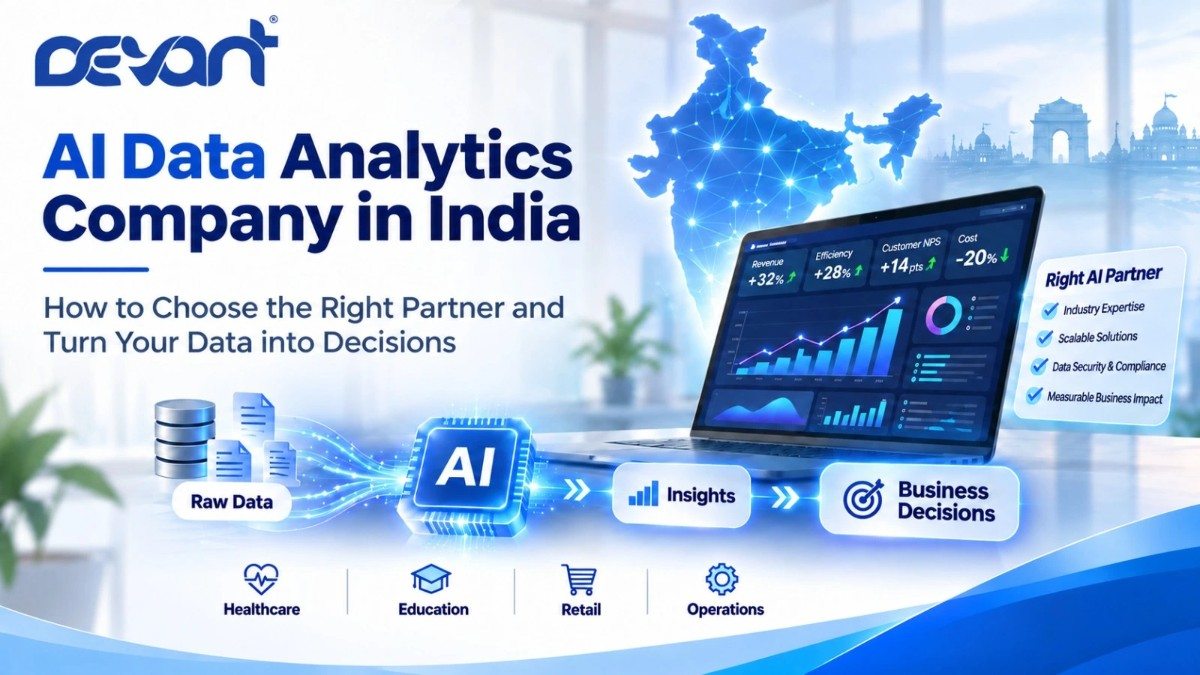
AI data analytics adds machine learning, predictive modelling, and automation on top of that foundation. The system learns patterns from your historical data, spots trends that a human might miss, flags unusual behaviour as it happens, and forecasts what is likely to come next. Instead of waiting for a monthly report, a business owner can see that a particular product is likely to run out of stock next week, that a certain group of customers is about to stop buying, or that a campaign is underperforming in one city while doing very well in another.
Put simply, traditional analytics tells you what happened, while AI data analytics helps you understand what is going to happen and what to do about it. That shift from reporting to prediction is what makes the technology so valuable for growing businesses.
India has quietly become one of the most active places in the world for data and AI work, and there are a few clear reasons for it. First, the country has a very large pool of engineers, data scientists, and analysts who are comfortable with modern tools and programming languages. Second, the rapid growth of digital payments, e-commerce, online education, telemedicine, and mobile-first services has created enormous volumes of data that businesses want to put to use.
Third, cost matters. Indian companies can deliver high-quality analytics and AI development at a price that is far more accessible than many global alternatives, which makes advanced technology reachable even for small and mid-sized businesses. Finally, there is a cultural shift happening inside organisations themselves. More founders, school administrators, hospital managers, and business heads now expect decisions to be backed by numbers, not just instinct. That demand is pushing the whole ecosystem forward.
For a business looking for a partner, this is good news. It means there are many capable options. It also means the market is crowded, and it is easy to end up with a vendor that talks well but delivers little. That is why knowing what good looks like is so important.

One of the best ways to understand the value of AI analytics is to look at how it works in real settings. The examples below are not limited to large corporations. Many of them apply just as well to a single school, a mid-sized clinic, or a growing online store.
In education, institutions are using analytics to track student attendance, performance trends, fee collection patterns, and admission enquiries. When this data is brought together, a school or college can identify students who may need extra academic support, predict which enquiries are most likely to convert into admissions, and plan resources more accurately. Management systems that already collect this data become far more powerful once an analytics layer is added on top.
In healthcare, hospitals and clinics generate huge amounts of information through patient records, appointments, billing, pharmacy, and diagnostics. AI analytics can help predict patient footfall, reduce waiting times, monitor bed occupancy, spot billing errors, and highlight departments that need attention. Done responsibly, with proper attention to privacy, it supports better care and smoother operations at the same time.
In retail and e-commerce, analytics helps businesses understand buying behaviour, forecast demand, set smarter prices, and personalise offers. A store that knows which products sell together, which customers are loyal, and which items are about to run out can plan its stock and marketing with far less guesswork.
In banking, finance, and lending, AI models support fraud detection, credit risk assessment, customer segmentation, and collection planning. In manufacturing, predictive analytics helps teams anticipate machine breakdowns before they happen, improve quality control, and reduce wastage. In digital marketing, analytics connects website traffic, search performance, social media engagement, and lead data so that teams can see which efforts are actually bringing in business and which are only bringing in vanity numbers.
Not every company that uses the phrase AI data analytics offers the same depth of service. A reliable partner should be able to support you across the full journey, from messy raw data to decisions that people actually act on. Here is what that journey usually includes.
It starts with data consolidation and cleaning. Most businesses keep information in many places, such as accounting software, CRM tools, spreadsheets, websites, and management systems. A good analytics partner begins by connecting these sources, removing duplicates and errors, and creating one reliable view of the truth. Without this step, even the smartest model will produce unreliable results.
Next comes dashboards and business intelligence. These give leaders a clear, visual, real-time picture of performance using tools such as Power BI, Tableau, Looker Studio, or custom-built dashboards. The best dashboards are simple enough that a non-technical manager can read them in a minute and know what needs attention.
Then comes predictive analytics and machine learning. This is where the AI part truly begins, with models that forecast sales, predict customer churn, estimate demand, detect anomalies, or score leads. Alongside this, many companies also offer custom AI development, including chatbots, recommendation engines, document processing, and workflow automation designed around a specific business problem.
Finally, a strong partner provides training, support, and ongoing improvement. Analytics is not a one-time project. Business conditions change, data grows, and models need to be reviewed and refined. A company that disappears after delivering the first dashboard is not a long-term partner.

With so many options available, choosing the right company can feel overwhelming. The good news is that a few simple checks can help you separate genuine partners from the rest.
Begin by looking at relevant experience. Ask whether the company has worked with businesses in your industry, or at least with similar data challenges. A team that understands how a school, hospital, or retail business actually operates will ask better questions and build more useful solutions than a team that only knows technology in the abstract.
Pay attention to how they talk about your problem. A good company will spend time understanding your goals before recommending a tool or a model. If the first conversation is mostly about their technology and very little about your business, that is a warning sign. The best analytics projects start with a clear business question, such as reducing customer drop-off or improving collection efficiency, and then work backwards to the data and tools needed.
Look closely at data security and compliance as well. You will be sharing sensitive information, so the company should be able to explain how data is stored, who can access it, and how privacy is protected. This matters especially for healthcare, education, and finance, where the data is personal and the responsibility is high.
Check for transparency in pricing and delivery. Clear timelines, defined deliverables, and honest communication about what is and is not possible are signs of a mature team. Be careful of anyone who promises dramatic results without having seen your data. Finally, ask about support after launch. The real value of analytics shows up over months, not days, so you want a partner who will stay involved as your needs grow.
Even with a good partner, some mistakes appear again and again. The most common one is starting with the technology instead of the problem. Businesses sometimes decide they need AI because it sounds modern, without being clear about what they want to improve. This usually leads to impressive demos and very little real impact.
Another frequent mistake is ignoring data quality. If records are incomplete, inconsistent, or entered carelessly, no algorithm can fix that. Investing a little time in building good data habits within the team pays off many times over. A third mistake is expecting instant results. Meaningful models need enough historical data and some time to be tested and tuned. And finally, many organisations forget about people. A dashboard that nobody understands or trusts will not change any decision, so training and adoption deserve as much attention as the technology itself.
At Devant IT Solutions, we believe that data should make life simpler for the people who run a business, not more complicated. As an India-based IT company, we work with organisations across education, healthcare, and business services, and we bring together custom software development, management systems, digital marketing, analytics, and IT consultancy under one roof. That combination matters, because the most useful analytics usually comes from understanding the systems that create the data in the first place.
Our approach begins with listening. We take time to understand your goals, your current tools, and the decisions you want to make with more confidence. From there, we help you bring scattered data together, build clear dashboards that your team can actually use, and develop AI-powered features such as forecasting, automation, and smart reporting where they genuinely add value. Because we also build management systems such as hospital, college, and school management software, we can connect analytics directly to the daily workflows where your data is created, which saves time and avoids the usual gap between software and reporting.
We also believe in keeping things practical. Not every business needs a complex machine learning model on day one. Sometimes the biggest win comes from a well-designed dashboard and a clean data process, with advanced AI added step by step as the business is ready. Our goal is to help you start where you are and grow at a pace that makes sense.
The next few years will bring even more change. Businesses are moving towards conversational analytics, where a manager can simply ask a question in plain language and receive an answer backed by live data. Automation is also growing, with systems that not only flag a problem but take the first corrective step on their own. At the same time, there is rising awareness around responsible AI, data privacy, and transparency, which means companies that handle data carefully will earn more trust.
For Indian businesses, the opportunity is significant. Those that build good data habits and choose the right partner today will be far better prepared to compete tomorrow. The cost of waiting is that competitors who start earlier will learn faster and decide better.
What does an AI data analytics company in India actually do?
An AI data analytics company helps businesses collect, clean, and analyse their data using machine learning and automation. This includes building dashboards, forecasting trends, detecting unusual patterns, and developing custom AI tools, so that decisions are based on evidence rather than guesswork.
How is AI data analytics different from traditional data analytics?
Traditional analytics mainly explains what has already happened through reports and charts. AI data analytics goes further by learning from patterns, predicting future outcomes, and often automating parts of the response. It is faster, more scalable, and better at uncovering insights that people might overlook.
Is AI data analytics only for large companies?
Not at all. Many small and mid-sized businesses, schools, clinics, and online stores benefit from analytics. The key is to start with a focused problem and a realistic scope, then expand over time. Cloud tools and affordable development have made this far more accessible than it used to be.
How long does it take to see results?
It depends on the complexity of the project and the quality of your data. Basic dashboards and reports can often be set up in a few weeks, while predictive models usually need more time for data preparation, testing, and refinement. A good partner will give you a clear timeline after reviewing your data.
How much does it cost to hire an AI data analytics company in India?
Costs vary widely based on the scope, the number of data sources, the type of models required, and the level of ongoing support. The best way to get an accurate figure is to share your requirements with a company and ask for a proposal with defined deliverables, rather than relying on a generic price list.
Is my business data safe with an analytics partner?
It should be, provided you choose a company that follows strong security practices. Ask how data is stored, who has access, how it is protected in transit, and what happens to it when the project ends. A trustworthy partner will answer these questions openly and put the key points in writing.
What should I prepare before approaching an analytics company?
Start by listing the business questions you want answered and the places where your data currently lives. You do not need perfect data, but a rough idea of your goals and sources will make the first conversation far more productive.
If you are ready to move from scattered numbers to clear, confident decisions, the team at Devant IT Solutions is here to help. Whether you want a simple dashboard, a smarter reporting system, or a fully custom AI solution, we will listen to your goals, look at your data, and suggest a practical path forward. Reach out to us today and let us explore how AI and data analytics can support the growth of your business.
To discuss your project, contact the Devant IT Solutions team through the enquiry form on our website. You can also follow Devant IT Solutions on LinkedIn, Facebook, and Instagram for regular updates on AI, data analytics, software development, and digital marketing insights from our team.