
If you run a growing business in India, there is a good chance you already feel it. The spreadsheets are multiplying, the WhatsApp groups are full of order updates, and every department seems to be working off a slightly different version of the truth. This is usually the exact moment when business owners start asking about ERP for growing businesses, and for good reason. As a company scales, the tools that once felt convenient start creating more confusion than clarity, and that is where a proper ERP system steps in.
At Devant IT Solutions, we work with businesses across India that are going through this exact transition. Some are manufacturers trying to keep track of raw materials and production schedules. Others are trading companies juggling multiple warehouses. What they all have in common is a simple realisation: growth without the right systems in place quickly turns into chaos. This blog walks you through what ERP really means, how to know when your business needs one, what a good ERP actually covers, and how modern tools like AI automation are changing the game for Indian companies.
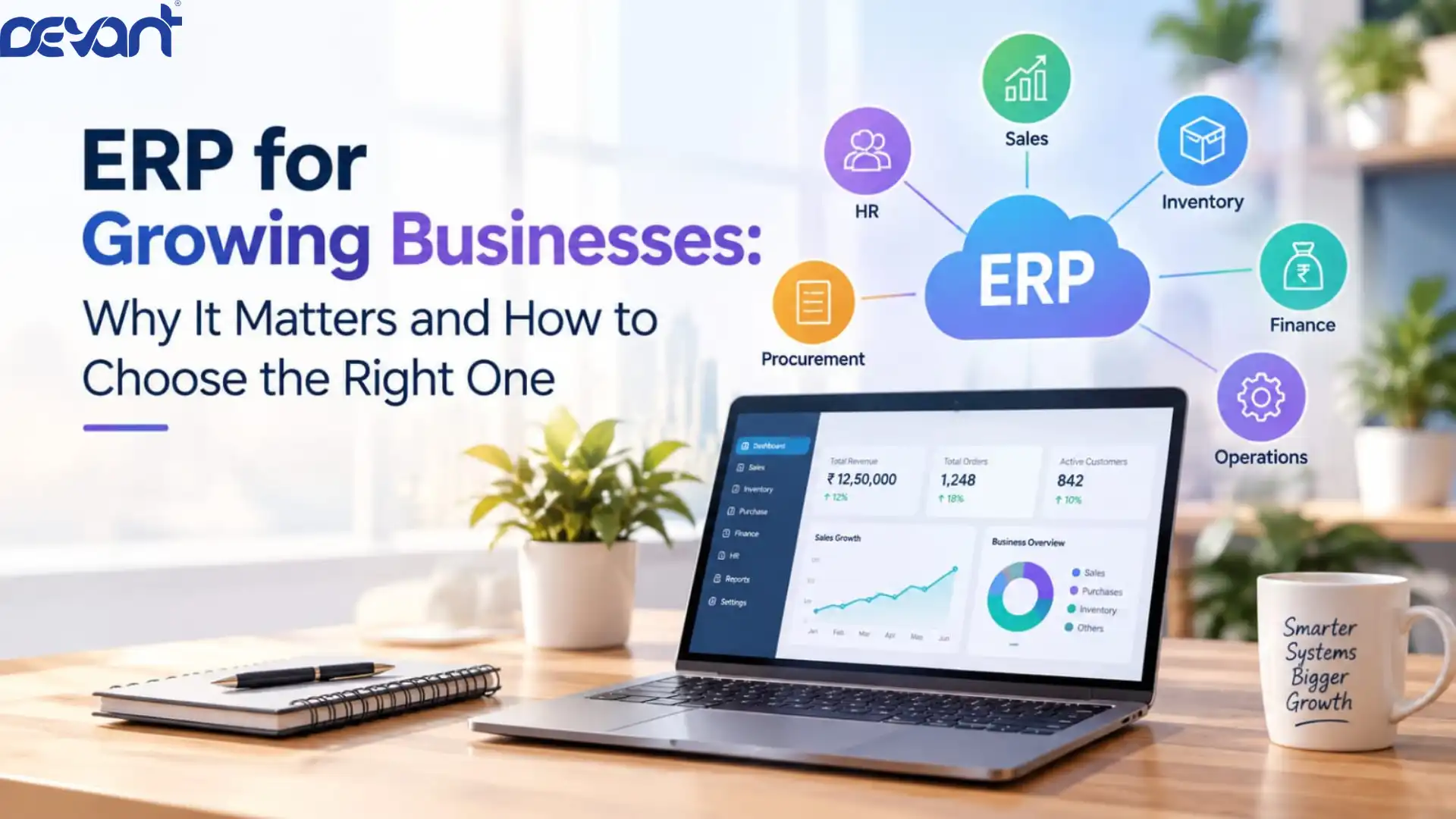
ERP stands for Enterprise Resource Planning, but the name sounds far more complicated than what it actually does. In simple terms, ERP software India companies use is a single system that connects all the different parts of a business, such as finance, inventory, sales, procurement, and human resources, so that everyone is working from the same live information.
Think of it like this. Instead of your accounts team using one spreadsheet, your warehouse team using another, and your sales team tracking orders in a notebook or a separate app, an ERP system brings all of that into one place. When a sale happens, the inventory updates automatically. When stock runs low, procurement gets notified. When an invoice is raised, the finance team sees it instantly. Nothing is lost in translation between departments.
For growing businesses in India, this matters more than ever. The Indian market is fast-moving, competitive, and increasingly digital. Customers expect quick responses, accurate order tracking, and smooth service. Regulatory requirements around GST, taxation, and compliance also demand cleaner and more organised financial records. A business that is still relying on scattered tools simply cannot keep up with this pace for long. ERP for growing businesses is not a luxury anymore. It is quickly becoming the backbone that lets a company handle more orders, more customers, and more complexity without falling apart internally.
Every growing business eventually reaches a point where the old way of doing things stops working. The tricky part is that this shift often happens gradually, so it is easy to miss the warning signs until things start slipping through the cracks.
One of the clearest signs is when your team spends more time managing data than actually using it. If your finance person is manually copying numbers from one spreadsheet to another, or your sales team is calling the warehouse every single day to confirm stock levels, that is a strong signal that your systems are not talking to each other anymore.
Another common sign is conflicting information. Maybe your sales report shows one number for monthly revenue, while your accounts team has a completely different figure. This usually happens when different departments maintain separate records instead of pulling from one shared source. Over time, this creates confusion, wastes hours in reconciliation, and can even lead to poor business decisions based on outdated or inaccurate numbers.
Delays are another red flag. If it takes days to generate a simple report, or if a customer's order gets delayed because nobody realised that a particular item was out of stock, disconnected tools are likely to blame. Spreadsheets are great for small teams and simple operations, but they were never designed to handle the complexity that comes with multiple departments, multiple locations, or a growing customer base.
Finally, pay attention to how your team feels about their daily work. If employees are frustrated with repetitive manual tasks, if onboarding a new team member takes weeks because there is no standard system to follow, or if leadership constantly feels like they are flying blind without real-time visibility into the business, these are strong indicators that it is time to move beyond spreadsheets. This is usually the exact stage where businesses start exploring ERP software India providers to bring order back into their operations.
A good ERP system is not just one big tool. It is a collection of connected modules that each handle a specific part of the business while sharing data with one another. Understanding these modules helps you see why ERP is so much more powerful than a set of separate apps.
The finance module is usually the heart of any ERP system. It handles accounting, billing, expense tracking, and financial reporting. Because it is connected to every other module, the finance team does not have to wait for other departments to manually share numbers. Sales figures, purchase costs, and payroll expenses flow into the finance module automatically, giving business owners a real-time picture of profitability instead of a month-old snapshot.
The inventory module keeps track of stock levels, movement between warehouses, and reorder points. For businesses dealing with physical products, this is often the module that saves the most time and money. Instead of manually counting stock or guessing when to reorder, the system tracks everything in real time and can even flag items that are running low before they actually run out.
The HR module manages employee records, attendance, payroll, and sometimes recruitment as well. As a business grows and hires more people, manually tracking leaves, salaries, and compliance details becomes a serious burden. An HR module built into the ERP keeps all employee-related data organised and easily accessible, which is especially useful during audits or performance reviews.
The sales module tracks orders, customer information, quotations, and the entire sales pipeline. When this module is connected to inventory and finance, something interesting happens. A salesperson can check real product availability before promising a delivery date, and once an order is confirmed, invoicing and stock updates happen automatically without anyone needing to manually enter the same information twice.
The procurement module manages purchase orders, vendor relationships, and supply chain activities. When procurement is linked to inventory, the system can automatically suggest when to reorder materials based on actual usage patterns, rather than relying on someone's memory or a rough estimate.
What makes ERP genuinely powerful is not any single module on its own. It is how these modules talk to each other. A sale in the sales module affects stock in the inventory module, which affects reorder points in procurement, which affects cash flow in finance, and all of this can influence hiring decisions tracked in HR. Instead of five separate systems working in isolation, you get one connected view of your entire business. This is the real difference between using scattered software tools and adopting proper ERP software India businesses trust to run their operations smoothly.

If ERP systems were already useful a decade ago, the addition of AI has made them genuinely transformative. Today, AI-powered ERP solutions are helping Indian companies move from simply recording data to actually using that data to make smarter decisions, often without any manual effort at all.
One of the biggest changes is in forecasting. Traditionally, predicting how much stock to order or how much revenue to expect next quarter relied heavily on human judgement and past experience. Modern ERP systems now use AI to study historical sales patterns, seasonal trends, and even external factors like market demand, and generate far more accurate forecasts. This means fewer surprises, whether that is running out of a popular product during a festive season or overstocking something that barely sells.
Inventory decisions have also become noticeably smarter. AI agents built into ERP systems can automatically recommend when to reorder stock, which suppliers offer the best pricing at a given time, and even flag unusual patterns, such as a sudden spike in returns for a particular product. Instead of a warehouse manager manually reviewing spreadsheets every morning, the system quietly does this analysis in the background and only raises an alert when something actually needs human attention.
Day-to-day operations benefit as well. Many modern ERP platforms now include AI agents that can handle repetitive tasks such as matching invoices to purchase orders, flagging discrepancies in financial entries, or even answering simple internal queries like how much stock is left of a particular item. This frees up employees to focus on tasks that genuinely require human judgement, rather than spending hours on manual checks.
For Indian companies specifically, this shift matters a great deal. Many growing businesses operate with lean teams, where one person often wears multiple hats. AI automation inside an ERP system acts like an extra set of hands that never gets tired and never misses a detail. It does not replace the team, but it does remove a lot of the repetitive burden that used to eat up valuable time. As more companies adopt AI-powered ERP solutions, the gap between businesses that operate efficiently and those that struggle with manual processes is only going to widen.
Once a business decides it needs an ERP system, the next big question is whether to go with ready-made software or invest in something built specifically for their operations. Both options have their place, but the right choice depends heavily on how your business actually works.
Off-the-shelf ERP software is designed to serve a wide range of businesses with generic, one-size-fits-all features. It is often quicker to set up and can be a reasonable starting point for very small businesses with simple, standard processes. However, the same features that make it broadly applicable also make it somewhat rigid. If your business has a unique workflow, a specific approval process, or an industry-specific requirement, you may find yourself forcing your operations to fit the software rather than the other way around.
This is where custom ERP development India companies like Devant IT Solutions offer a genuinely different experience. A custom-built ERP system is designed around how your business actually operates, not around a generic template. If your sales process has three approval stages instead of one, the system reflects that. If your inventory tracking needs to account for batch numbers or expiry dates specific to your industry, that gets built in from the start rather than bolted on as an afterthought.
Growing businesses, in particular, benefit from this tailored approach. As a company scales, its processes rarely stay static. New departments get added, workflows get refined, and reporting needs become more specific. A custom ERP system can grow and adapt alongside the business, rather than requiring the business to work around the limitations of a fixed, generic tool. It also tends to integrate more smoothly with other software the company already uses, since it is built with those specific connections in mind from day one.
There is a cost and time consideration here, of course. Custom ERP development generally requires more upfront investment and a longer development timeline compared to simply subscribing to an off-the-shelf product. But for businesses that are serious about scaling efficiently over the next several years, this investment often pays for itself many times over through better efficiency, fewer workarounds, and a system that genuinely fits the way the business runs. This is exactly why so many growing companies in India are now leaning toward custom ERP development India providers instead of settling for generic software that only solves part of the problem.

If your business is starting to feel the strain of spreadsheets, disconnected tools, or software that just does not fit the way you work, we would love to have a conversation. Devant IT Solutions has helped businesses across India design and build ERP systems that actually match their real workflows, not the other way around. Feel free to reach out whenever you are ready to talk.
Do follow us on our social media channels for more updates on ERP, technology, and everything we are building at Devant IT Solutions. We would love to stay connected with you there as well.
Growing a business is exciting, but it also brings a level of complexity that spreadsheets and disconnected tools simply were not built to handle. ERP for growing businesses is not about adding another piece of software to your stack. It is about bringing every part of your operations, from finance to inventory to HR, into one connected system that gives you clarity instead of confusion. Whether you choose a ready-made solution to start or decide that custom ERP development India expertise is the better long-term fit, the important thing is recognising when your business has outgrown its current tools and taking that next step with confidence. With the right ERP system in place, and increasingly with the help of AI-powered ERP solutions, growing businesses in India are better equipped than ever to scale smoothly, make smarter decisions, and stay ahead in a competitive market.
ERP, or Enterprise Resource Planning, is a system that connects different parts of a business, such as finance, inventory, sales, and HR, into one platform. Growing businesses need it because manual tools like spreadsheets become unreliable and time-consuming once operations become more complex.
If your team is spending more time managing data than using it, if different departments have conflicting numbers, or if delays and errors are becoming common, these are strong signs that it is time to consider ERP software India providers.
Custom ERP development usually requires more upfront investment than off-the-shelf software, but it is built specifically around your workflows. For many growing businesses, this leads to better long-term efficiency and fewer costly workarounds.
AI-powered ERP solutions help businesses with more accurate forecasting, smarter inventory decisions, and automation of repetitive daily tasks, allowing teams to focus on work that genuinely needs human attention.
Yes, especially with a custom-built system. As your business adds new departments, processes, or requirements, a well-designed ERP system can be adapted to match those changes instead of holding your business back.
Ready to explore what a well-built ERP system could do for your business? Reach out to Devant IT Solutions, and let us help you build something that truly fits the way you work.
Stay connected with Devant IT Solutions on social media for regular updates on digital marketing, SEO, and the latest shifts in AI search. Follow us today so you never miss an insight that could help your business grow.