
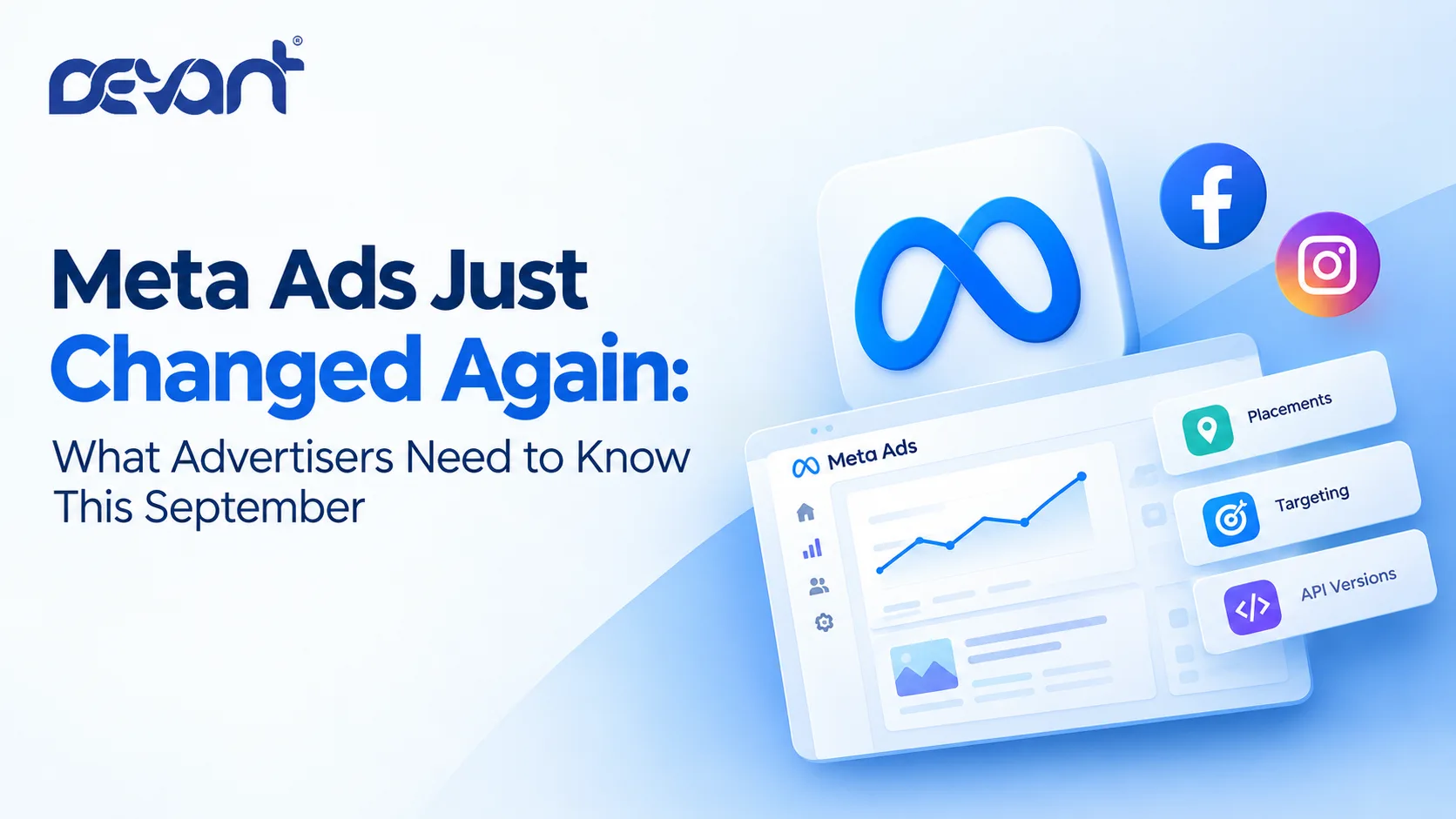
If you manage Facebook or Instagram ad accounts, you know the platform rarely stands still. Since August 2026, Meta has been tightening how placements work, adding new audience exclusion tools and setting deadlines for older API versions. Some of these changes are still rolling out account by account, so it is worth understanding them before your next campaign setup, especially with the busy Q4 season approaching.
At Devant IT Solutions, we manage ad accounts across several industries, so updates like these directly shape how we plan and optimise campaigns for our clients. Here is a practical look at what has changed, what is still unconfirmed and what it means for your strategy.
Until now, an advertiser who did not want ads in a particular placement, such as Audience Network, could simply untick it at the ad set level. In August 2026, some advertisers began seeing a notice in Ads Manager saying that excluding placements, platforms, devices and operating systems will no longer be available for their ad sets. The notice carries no rollout date, and the change is appearing gradually. Advertisers have reported it first on Sales and Leads campaigns, although Meta had not published a full announcement at the time of writing. The safest approach is to check your own ad sets rather than rely on a single timeline.
The replacement is the placement value rule, which lets you adjust bids for specific placements. You can raise a bid by up to a thousand percent or lower it by up to ninety percent, but you cannot switch a placement off. In practice, a placement bid down by ninety percent becomes much less likely to win impressions, yet it can still receive some budget, particularly where inventory is cheap. Only a limited set of placements, roughly seven according to current reports, is eligible for these bid adjustments.
There is an important point for brand safety. Account-level placement restrictions and content category exclusions remain available. If you have a genuine brand-safety concern, such as keeping ads away from Audience Network entirely, the account-level controls are now the place to enforce it, while value rules suit performance-based decisions.
In August 2026, Meta introduced exclusion-only custom audiences. This is a type of customer list audience that can only be used to keep people out of an ad audience. It cannot be used to include anyone, and once created it cannot be converted into a regular custom audience. Meta's stated purposes are compliance-focused, such as excluding people who have opted out of a business's products or people the business has a legal or regulatory obligation not to target.
This feature was not launched as a replacement for placement controls, but in our view it fits the same direction. As manual placement choices become less available, well-maintained exclusion lists become a more valuable way to protect your budget. An acquisition campaign, for example, benefits from excluding existing customers so that you are not paying new-customer costs to reach people who already buy from you.

Meta's Andromeda system is now fully in place. Sources indicate that it rolled out across most objectives and placements through 2025, so its effects have been visible for some time. Meta describes Andromeda as a personalised ad retrieval system, which selects candidate ads for each person before ranking takes place. Many performance marketers have concluded from this that creativity now matters more than detailed audience settings, because the image, copy and format all influence who sees an ad.
Meta does not say that creative replaces audience targeting, so it is more accurate to treat this as a strong practical lesson than an official rule. Businesses should test a wider range of distinct creative concepts, and refresh them regularly, since a weak ad has fewer manual targeting levers to compensate for it.
Several industry reports say that Meta lowered the weekly conversion threshold for Advantage+ Shopping campaigns, now often called Advantage+ Sales, from fifty to twenty-five in April 2026. If accurate, this opens the campaign type to smaller advertisers who previously lacked the volume to qualify. However, Meta's public learning documentation was still reported to refer to roughly fifty optimisation events, so we recommend checking what your own account shows before restructuring campaigns around the lower figure.
For teams that connect to Meta's APIs for reporting, automation or custom integrations, there are two dates to note. Graph API version 20.0 is scheduled for removal on September 24, 2026, and Marketing API version 24.0 is available until October 6, 2026. Meta released Graph API v26.0 and Marketing API v26.0 on July 29, 2026, and several changes announced with that release extend to all remaining versions on October 27, 2026. Any tool, script or dashboard still pointing at an older version should be checked and upgraded well before these dates.

Taken together, these updates show a platform that wants advertisers to hand over more control in exchange for automated performance. Placement decisions are moving toward Meta's system, and creative is carrying more of the weight that audience building once did. At the same time, Meta is adding a few precise guardrails, such as exclusion-only audiences and account-level controls.
For most businesses, the sensible response is to spend less effort on manual placement tweaks and more on varied, high-quality creative. Review your account-level placement and content controls, rebuild suppression lists such as opt-outs and existing customers, and check which API version your reporting tools use.
Not at the ad set level once the change reaches your account. You can use a placement value rule to reduce a placement's bid by up to ninety percent, or use account-level placement restrictions for hard exclusions.
It is a bid adjustment applied to a specific placement, device or operating system. It can raise a bid by up to a thousand percent or lower it by up to ninety percent, but it cannot switch a placement off completely.
It is a customer list audience that can only be used to exclude people from your ads. It cannot be used for inclusion and cannot be converted into a regular custom audience after creation.
Andromeda is Meta's ad retrieval system, which helps decide which ads are considered for each person. Many marketers believe it gives creative more influence over who sees an ad, so varied and well-made creative has become more important.
Graph API v20.0 is scheduled for removal on September 24, 2026, and Marketing API v24.0 is available until October 6, 2026. Integrations still using these versions should be upgraded to avoid disruption to reporting, automation or ad management.
Meta's advertising platform is changing fast, and keeping campaigns performing well takes ongoing attention. At Devant IT Solutions, we manage Meta ad accounts for clients across multiple industries and stay on top of platform shifts like these, so our clients do not have to. Whether you need help adapting your placement and audience strategy, strengthening your creative for Andromeda or making sure your API integrations stay current, our team is ready to help.
Get in touch with Devant IT Solutions today to talk about your Meta advertising strategy.
Reach out to us to learn more about our digital marketing, SEO and paid advertising services, or to start a conversation about your next campaign. You can also follow Devant IT Solutions on our social media channels to stay updated on the latest trends in IT, digital marketing and technology.