
Meta has never really stood still, but 2026 has been an especially busy year for the platforms that power Facebook, Instagram, WhatsApp, and Threads. From new AI features baked directly into the apps people already use, to a completely reworked subscription model, Meta is reshaping how individuals create content and how businesses reach their audiences. For marketers, content teams, and business owners across India, keeping track of these changes isn't optional anymore - it's part of staying visible online.
At Devant IT Solutions, we work closely with businesses that depend on Facebook and Instagram for visibility, lead generation, and customer engagement. So we thought it was worth pulling together a clear, practical roundup of what has actually changed on Meta's platforms recently, and what it might mean for the way you plan your content and marketing going forward.
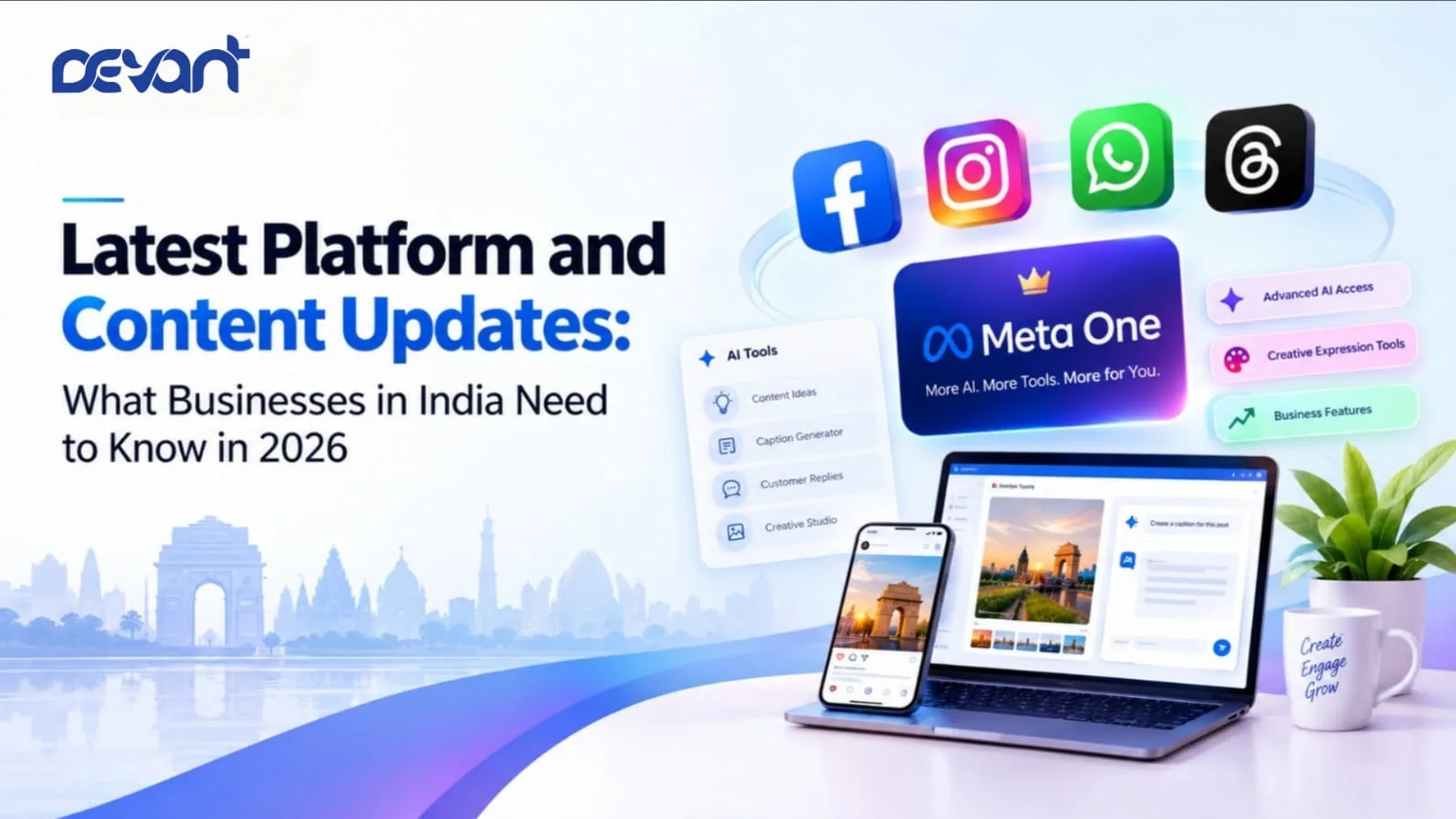
One of the biggest announcements this month is Meta One, a new subscription service that spans Facebook, Instagram, WhatsApp, and Meta AI. Unlike earlier subscription offerings that were mostly about verification badges, Meta One is built around giving subscribers more AI usage along with a set of enhanced expression tools and features aimed specifically at creators and businesses.
In practical terms, this signals that Meta wants AI capability itself to become a paid differentiator across its family of apps, rather than something that lives quietly in the background. For businesses that already lean on Meta AI for content ideas, captions, or customer replies, a subscription tier like this could soon become a genuine part of the marketing budget conversation, not just a nice-to-have.
Meta AI's mobile apps have picked up a new Voice Mode, letting people speak to the assistant instead of typing every request. This fits a broader pattern across the industry, where voice interaction is being treated as a natural extension of chat-based AI rather than a separate feature.
Alongside this, Facebook Messenger users can now share files directly with Meta AI within a conversation, which opens the door to quicker document summaries, faster back-and-forth on drafts, and less friction when someone wants the AI's help on something they already have sitting on their phone. Meta Verified users are also getting their Meta AI usernames reserved for them, which is a small but telling sign of how identity and AI assistants are becoming more tightly linked on these platforms.
Perhaps the most consequential update for businesses is the rollout of Meta Business Agents on Instagram. These AI-driven agents were already live on WhatsApp and Messenger, and Meta has confirmed that more than a million businesses are using them every week to handle customer conversations and complete sales without needing a human to reply to every single message.
What makes this shift interesting is where Meta is taking the idea next. These agents are not just meant to answer frequently asked questions anymore. Meta has said it wants them to summarise conversations, surface recurring customer requests, and eventually offer a kind of competitive intelligence based on what customers are asking across a business's social channels. In other words, the data sitting inside your Instagram DMs is quietly becoming a source of business insight, not just a support queue that needs clearing.
For businesses running education, healthcare, retail, or service-based accounts, this is worth watching closely. If your Instagram inbox already handles admissions queries, appointment requests, or product questions, a Business Agent could soon be doing a meaningful share of that first response - and the conversations it has could tell you things about your customers that your existing analytics never surfaced.

Meta AI has also been given the ability to connect directly with a business's own data sources, including Facebook and Instagram analytics, Meta Ads accounts, and Google Workspace. The idea is to let Meta AI generate insights and recommendations without a marketer having to pull reports manually, and in some cases, it can turn its findings into ready-made resources such as executive-style presentations.
This matters a great deal for smaller marketing teams that don't have a dedicated analyst on staff. It also raises a fair question about how much of your account's performance data you're comfortable letting an AI system access and interpret on your behalf, which is something every business should think through before switching this on for client accounts.
Instagram's free video editing app, Edits, has picked up several new features aimed at people who regularly produce vertical video content. Project folders now make it easier to organise multiple videos in progress at once, and new AI tools can add subtle motion to still images, which is a quick way to make a static graphic or product photo feel more alive in a Reel. Saved text styles have also been added, so creators and social teams can keep a consistent look across a brand's Reels without rebuilding the same caption style every time.
For content teams juggling multiple client accounts, these small workflow improvements add up. Being able to save a text style once and reuse it, or keep separate projects tidily organised, cuts down on the repetitive setup work that eats into time better spent on ideas and strategy.
Threads has introduced parental supervision tools for teenage users in the Asia-Pacific region. This is part of a wider effort across Meta's apps to give parents more visibility and control over how younger users engage with the platform, and it follows similar safety features that have already been rolled out on Instagram.
While this update is aimed at families rather than businesses, it is a useful reminder that platform policies around younger audiences continue to tighten. Any brand whose content or advertising could reach a teenage audience should keep an eye on how these supervision features evolve, since they often come bundled with new restrictions on ad targeting and content visibility for that age group.
Taken together, these updates point in a fairly clear direction. Meta is pushing AI deeper into everyday business use, from the assistant that reads your ad performance to the agent that replies to your DMs, and it is starting to charge for a slice of that capability through Meta One. At the same time, the creative tools that power everyday content, like Instagram Edits, are getting steadily more capable, lowering the effort needed to produce good-looking video content in-house.
The practical takeaway for businesses is to treat these changes as an opportunity rather than just another thing to keep up with. If your business already handles a decent volume of Instagram or WhatsApp messages, it may be worth testing a Business Agent for routine queries so your team can focus on higher-value conversations. If your content calendar leans heavily on Reels, the updates to Edits are worth exploring for the time they can save. And if you are already paying for AI tools elsewhere in your stack, it is worth watching how Meta One's pricing and features shape up before deciding whether it belongs in your toolkit too.
As always, the businesses that adapt early tend to get the most value out of platform changes like these, simply because they have more time to learn what works before the tactic becomes common practice.

Meta One is a new subscription service spanning Facebook, Instagram, WhatsApp, and Meta AI. It offers subscribers more AI usage along with enhanced expression features and tools designed for creators and businesses.
They are AI-powered agents that handle customer conversations on Meta's messaging platforms. Already active on WhatsApp and Messenger, they are now rolling out on Instagram, and can respond to queries, complete sales, and increasingly surface insights from customer conversations.
Yes, Meta AI can now connect with sources such as Facebook and Instagram analytics, Meta Ads accounts, and Google Workspace to generate insights and recommendations, and it can turn some findings into presentation-ready formats.
Most of these updates, including Business Agents, Meta AI's data insights, and the new Edits features, are built to be useful at any scale. Smaller businesses without dedicated marketing or analytics teams may actually benefit the most, since these tools reduce the manual work involved in customer replies and performance reporting.
Meta typically announces major changes through its Newsroom and its Business Help Centre, but the pace of updates can make it hard to keep up while running a business. Partnering with a digital marketing team that actively monitors these changes is often the simplest way to stay current without it becoming a full-time job.
Keeping up with every Meta update while also running your day-to-day marketing can be a lot to manage on your own. At Devant IT Solutions, we help businesses across India make sense of these platform changes and turn them into practical, results-driven content and advertising strategies. Whether you want to explore Meta Business Agents for your customer conversations, refresh your Reels content, or simply make sure your social media presence keeps pace with what Meta is rolling out next, our team is ready to help.
Get in touch with Devant IT Solutions today to discuss how we can support your digital marketing and content strategy.
Reach out to us to learn more about our digital marketing, SEO, and content services, or to start a conversation about your next campaign. You can also follow Devant IT Solutions on our social media channels to stay updated on the latest trends in IT, digital marketing, and technology.